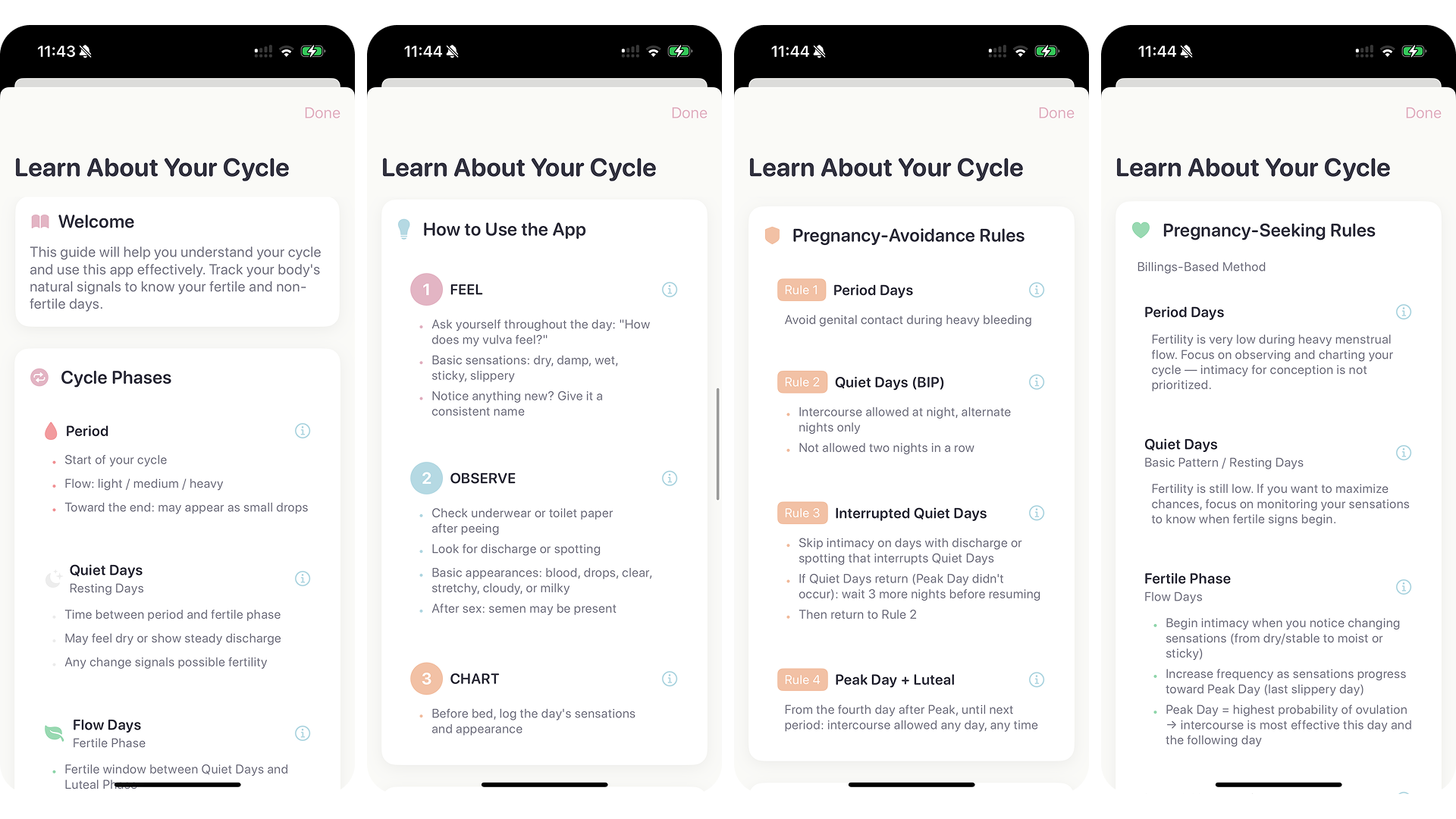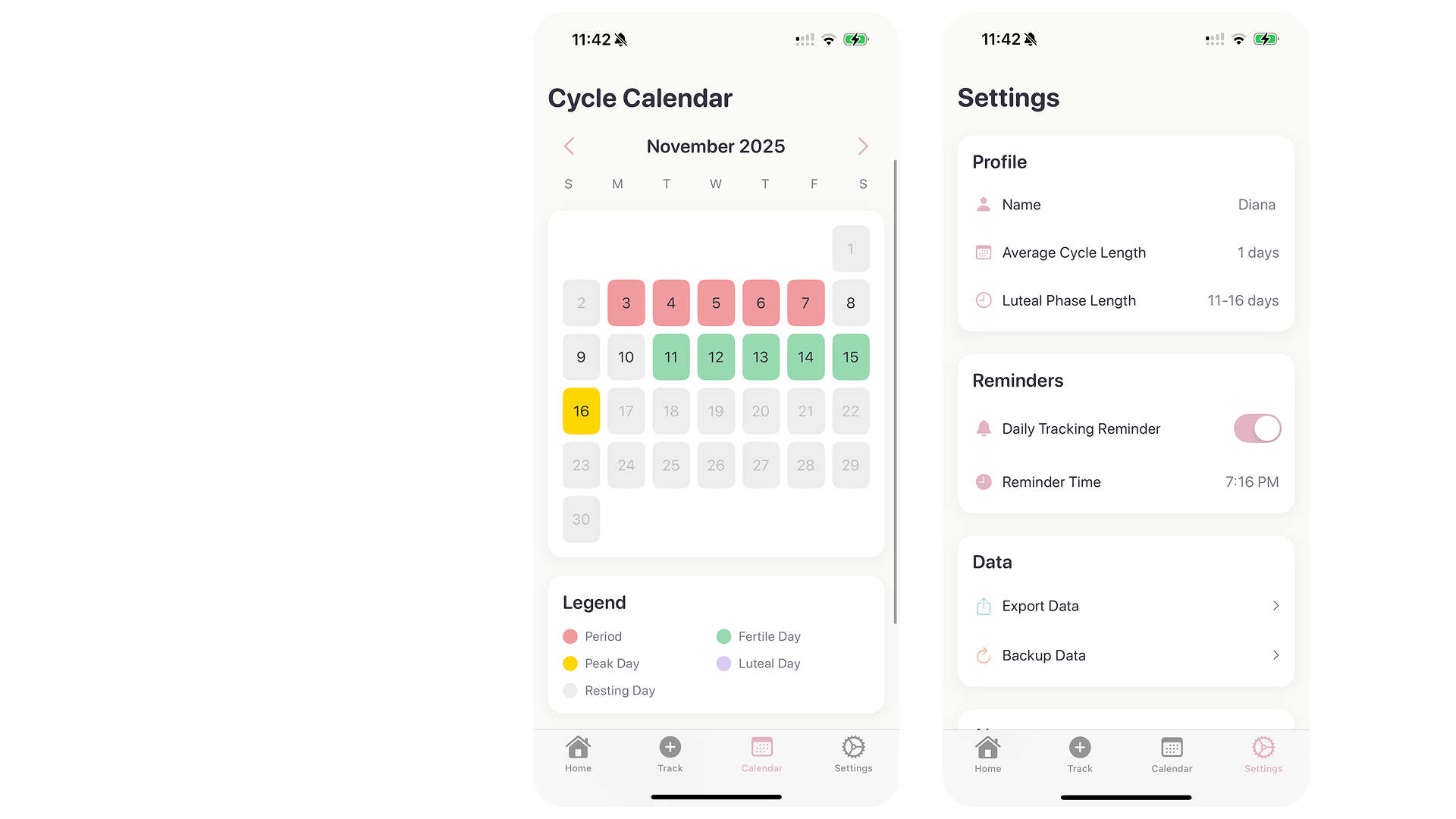
Luna is a menstrual and hormonal cycle tracking app conceived as an alternative to commercial health platforms that monetize intimate data. Many existing cycle-tracking apps require paid subscriptions and collect highly personal information, often aggregated and sold to third parties for targeted digital marketing. These practices turn women’s hormonal data into a commercial asset. Luna emerges from a clear position: users should not have to trade privacy for self-knowledge.
Beyond data extraction, most commercial apps are overloaded with features that users rarely need, and they make it difficult to export or fully control personal data. Luna responds by offering a minimal, transparent, and user-owned system focused on daily awareness rather than prediction-driven consumption.
The app is structured around four core sections.
The development process evolved through iterative experimentation. The first iteration focused on building the algorithm and backend to explore cycle prediction, supported by an initial interface draft in Figma. In the second iteration, the team conducted in-depth research on menstrual cycle algorithms used in scientific studies worldwide. This research informed a revised system description, which was then translated into a functional prototype using Claude Code. ChatGPT played a mediating role by transforming conceptual explanations into structured prompts, enabling a fluid collaboration between human insight and code generation.